Every year after Thanksgiving, the same ritual plays out across Atlanta. The ladder comes out of the garage, the tangled box of lights gets dragged down from the attic, and a free Saturday disappears into clips, extension cords, and burned-out strands. Then, a few weeks later, it all happens again in reverse, often in colder, wetter weather.
There’s another way to light your home for the holidays, and it doesn’t involve a ladder at all. This guide compares permanent Christmas lights with the hang-them-every-year approach, so you can decide which one actually fits your home and your life.
What Are Permanent Christmas Lights?
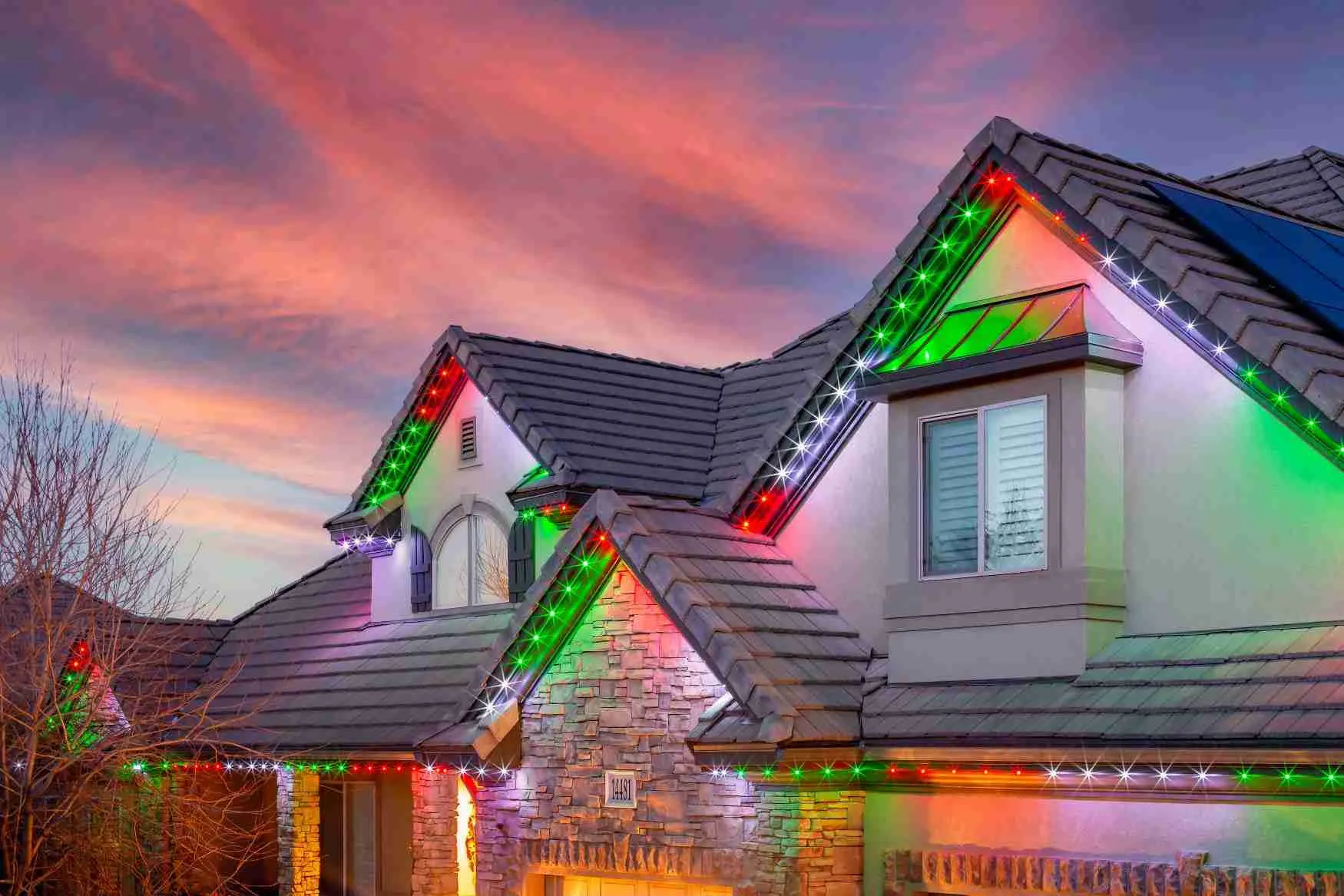
Permanent Christmas lights are small, individually controlled LED lights installed once along your roofline, where they stay year-round. Each light seats into a slim, color-matched aluminum track that’s fastened under the eaves or along the fascia, with the wiring hidden inside. By day, the system all but disappears against your trim. By night, it can be anything from a warm white glow to a full-color holiday display.
The lights are controlled from a smartphone app, so you choose colors, brightness, patterns, and schedules without touching the hardware. People call these systems by a lot of names, including permanent strip lights, permanent roofline lighting, perm lights, and permanent holiday lights, but they all describe the same idea: one professionally installed system that replaces the yearly cycle of buying, hanging, and removing seasonal strands.
That’s the core contrast with traditional holiday lighting. Hanging lights every year means temporary strands that go up in late fall and come down in winter. Permanent lights are a built-in feature of the home that you simply turn on.
The Real Cost: Five Years of Hanging vs. One Installed System
The honest way to think about cost is to compare the two approaches over time, not on day one. Traditional Christmas lights look cheaper up front, and a single season usually is. But that cost repeats every year, and it adds up in ways people tend to forget.
Each season of hanging lights yourself typically includes the price of new or replacement strands, clips, and cords, plus the value of the hours you spend installing and removing them. If you hire a seasonal crew instead, you’re paying an install-and-removal fee every year, and those fees recur for as long as you decorate. Over five years, that’s five rounds of spending for lighting you only use a few weeks at a time.
A permanent system flips that pattern. You make a larger one-time investment, and then the recurring costs largely go away. There’s no annual install fee, no yearly replacement strands, and the lights run on very little electricity. Over several years, the avoided costs offset a meaningful share of the upfront price, which is why so many homeowners come to see permanent lighting as a home upgrade rather than a holiday expense.
It helps to picture the timeline. With traditional lighting, year one, year two, year three, and beyond each carry their own bill, whether that’s your time or a crew’s fee, and the lights themselves wear out and need replacing along the way. With a permanent system, the big number lands once, in year one, and the following years cost almost nothing to operate and maintain. The longer you stay in your home, the more the comparison tilts toward permanent. There’s also a quieter benefit that’s easy to overlook: you reclaim the weekends. The hours spent untangling strands, climbing up and down, and packing everything away in January are hours you simply get back.
Because every home is different, there’s no single price tag, and the total depends mostly on the size of your roofline. For a full breakdown of what shapes the number, see our guide on permanent Christmas lights cost.
No More Ladders: The Safety Difference
Cost is easy to measure. Safety is the part people underestimate. Hanging holiday lights means working at height, on a ladder, often on a roofline, frequently in cold and slick conditions. Falls from ladders send thousands of people to the emergency room around the holidays every year, and a second or third story raises the stakes considerably.
Permanent lights installed by a professional team removes that risk entirely. The system is mounted once by a trained crew with the right equipment, and from then on you manage everything from an app. There’s no annual climb to hang lights, no reaching over gutters, and no taking strands down in January when the weather is at its worst. For multi-story homes and steep rooflines especially, that single change is reason enough for many homeowners to switch.

One System, Every Occasion
A big part of the value is that permanent lights don’t sit dark for eleven months. The same system you use for Christmas works all year, and you switch looks from the app in seconds.
- Holidays: Full-color Christmas displays, then orange for Halloween, red and white for Valentine’s Day, or red, white, and blue for the Fourth of July
- Everyday: A soft, warm white that flatters your home’s architecture and makes the entry more welcoming
- Game day: UGA red, GT gold, or your favorite Atlanta team’s colors, set in seconds before kickoff
- Security: Scheduled lighting that keeps your home looking lived-in when you’re away
Because the lights are individually controlled, you can run subtle accent lighting most nights and save the bold patterns for the occasions that call for them. App control also means scheduling, so the lights turn on at dusk and off at bedtime on their own, and automated holiday changes you set once and forget. One installed system quietly doing the work of holiday lights, everyday accent lighting, and security lighting is what makes it more than a seasonal novelty.
How Are Permanent Christmas Lights Installed?
Installation is a professional job, and understanding it helps explain why the finished look is so different from a DIY strand. Here’s what the process generally involves.
First comes design and measurement. A specialist looks at your roofline, peaks, dormers, and any other areas you want lit, then plans the layout and the exact length of track needed. Good design is what makes the final result look intentional rather than improvised.
Next is the track. A low-profile aluminum channel is custom-cut and color-matched to your home, then fastened cleanly along the eaves or fascia. The individual lights seat into this channel at even spacing, and the wiring is concealed inside, which is what gives permanent systems their built-in appearance.
Finally, the system is wired to a power source and controller and connected to the app. The crew tests the lights, sets up your zones and initial scenes, and walks you through controlling everything from your phone. A typical home is completed quickly by an experienced team, and once it’s done, the hard part never has to be repeated.
It’s worth knowing how long these systems last, since that’s central to the value. Permanent lights are built for the outdoors, with weather-resistant components and a durable aluminum channel designed to hold up through Atlanta heat, cold, wind, and rain for years. They need almost no maintenance beyond the occasional cleaning, and because the channels and connections are designed to be serviceable, individual sections can be addressed if anything ever needs attention. A quality system installed correctly is meant to be a long-term fixture of your home, not something you’ll be replacing in a few seasons.

DIY Kits vs. Professional Installation
You’ll find do-it-yourself permanent light kits for sale, and on paper they look like a way to save money. In practice, the gap between a DIY install and a professional one tends to show up fast, and it shows up where it’s hardest to hide: on the front of your home.
DIY installs commonly run into a few predictable problems. Spacing comes out uneven, so the line of light looks irregular instead of crisp. Track that isn’t cut and aligned carefully leaves visible gaps or waves. Wiring that isn’t fully concealed creates the exact cluttered look permanent lighting is supposed to eliminate. And all of the planning, measuring, cutting, mounting, and ladder work falls on you, which brings back the safety problem permanent lights are meant to solve.
A professional installation is different because the design and the execution are handled by people who do it constantly. The layout is planned for your specific architecture, the track is color-matched and precisely fitted, the wiring disappears, and the spacing is even from every angle. Just as important, the work is done by a licensed, insured crew, so you’re not the one on the roof.
This is also where choosing a local, design-led company matters more than chasing the lowest-cost product. National do-it-yourself brands hand you a box and leave the outcome to you. A local team designs around your home, installs it properly, and stays available afterward for service or additions. The lights themselves are only part of the result; the design and installation are what make a home look polished rather than patched together.
Are Permanent Strip Lights the Right Choice for Me?
Permanent Christmas lights aren’t the right answer for everyone, and it helps to be honest about that.
They’re an excellent fit if you decorate most years, if you’re tired of the ladder and the seasonal hassle, if you have a tall or complex roofline that’s difficult or dangerous to reach, or if you like the idea of lighting you can use for holidays, everyday ambiance, game days, and security from one app. For these homeowners, the convenience and the long-term value line up clearly.
They’re a weaker fit if you almost never decorate, or if you expect to move very soon and won’t be around to enjoy the payback. In those cases, traditional seasonal lighting may serve you better, and we’re glad to help with that too.
You can compare the two approaches in more detail in our permanent vs. seasonal lighting FAQ, and learn about our classic holiday service on our residential Christmas lighting page.
The Bottom Line
Hanging lights every year is familiar, and for occasional decorators it can still make sense. But for homeowners who light up most seasons, permanent Christmas lights answer the three things that make the annual ritual frustrating: the recurring cost, the ladder, and the limited, holidays-only payoff. A permanent system spreads its value across the whole year, removes the safety risk after a single install, and delivers a clean, built-in look that DIY strands rarely match.
If you’re weighing the switch, the best next step is to see what a custom system would look like on your home. Learn more about permanent outdoor lighting in Atlanta, and when you’re ready, request a free, no-obligation quote.